
Research
Digital Inclusion Gender

What Works to Close Digital Gender Gaps?

Published by
Charity Troyer-Moore, Giorgia Barboni, Erica Field, Rohini Pande, Natalia Rigol, Simone Schaner, Erik Jorgensen, Hemawathy Balarama
2025
Yale Inclusion Economics
View Resource

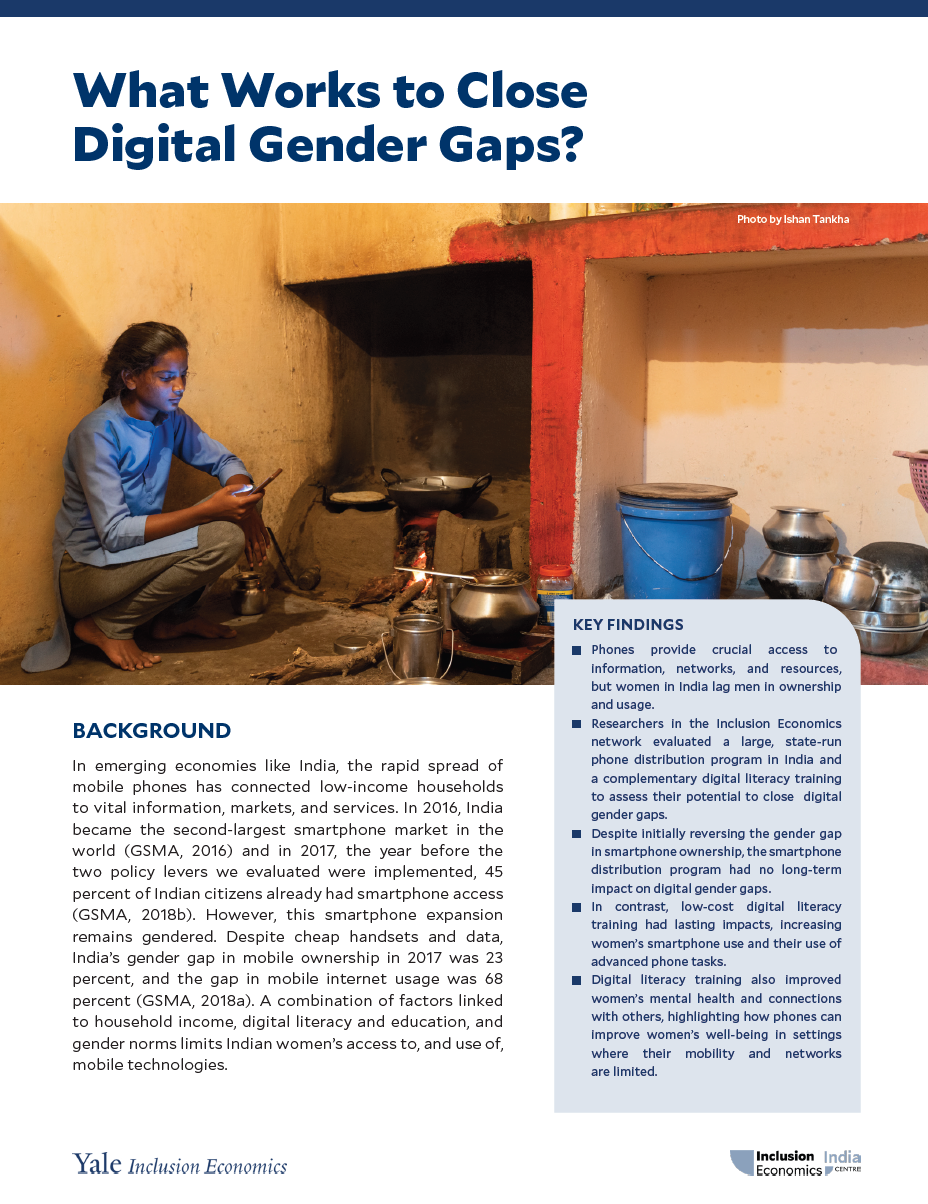
In rural India, researchers from Yale Inclusion Economics studied the effectiveness of two major interventions aimed at closing the digital gender gap: a state-run smartphone distribution program and a complementary digital literacy training. While the distribution of over two million free smartphones initially increased women’s phone ownership and advanced usage, these gains faded over time. In contrast, short, low-cost digital literacy trainings had a more durable effect—boosting women’s use of smartphones for advanced tasks and strengthening their social connections and mental health years later.

The study offers practical insights for policymakers and development practitioners: technology access alone is not enough. Programs must also address gendered barriers to usage—like digital literacy, confidence, and social norms—to create meaningful and lasting inclusion.

What Works to Close Digital Gender Gaps? presents key findings, policy lessons, and implications for digital inclusion efforts in low-resource settings.
Leave a Reply

View all comments

Related Resources

Read
article
Consumer Protection Data Privacy & Security Digital Inclusion Financial Service Providers
Break the bias
article
Consumer Protection Data Privacy & Security Digital Inclusion Financial Service Providers

Break the Bias: Evidence Shows Digital Finance Risks Hit Women the Hardest

By Majorie Chalwe-Mulenga, Yasmin Bin-Humam & Eric Duflos
CGAP (Consultative Group to Assist the Poor)
2022

Break the Bias: Evidence Shows Digital Finance Risks Hit Women the Hardest

This article explores evidence which shows that women are more likely to experience most risks identified in CGAP’s typology of 66 DFS consumer risks than men. CGAP observes that long-standing digital financial service (DFS) risks are not only getting worse, but new risks are emerging every year, and women are more vulnerable to DFS risks than […]
Read
Tool
Consumer Protection Data Privacy & Security Digital Inclusion Digital Transformation
DSG Tools Data Privacy and Security
Tool
Consumer Protection Data Privacy & Security Digital Inclusion Digital Transformation

DSG Toolkit: Data Privacy and Security

By Lauren Hendricks, Dennis Mello, Paulina (Paula) Rudnicka
Global Communities, Women for Women International
2022

DSG Toolkit: Data Privacy and Security

This tool is designed to help DSG implementers ask technology providers the right questions about their data security policies and protocols, with the goal of protecting the data privacy rights of DSG members.   Digital solution providers (e.g., fintech companies) are de facto custodians of group and member data, which can be prone to hacking, manipulation […]