Research
Financial Inclusion

Promoting Students’ Financial Responsibility through SILC and Financial Education: Report from the 2024 School Year in El Salvador, Guatemala, and Honduras

Published by
Anne Angsten Clark, Olawale Awoyemi, Medan Ampeni, John M. Oliver, Rashidat Mohammed, Dibal Sanya, Idrisa Buba Umoru, Rhoda Ezekeil
2025
Catholic Relief Services
View Resource

This report examines the impact of Classroom Savings and Internal Lending Communities (SILC) and financial education programs in schools across El Salvador, Guatemala, and Honduras. The findings highlight how these initiatives help students build financial skills, improve academically, and engage families.

Key Takeaways

  • SILC participation encouraged students to save regularly, set financial goals, and share savings habits with family members.
  • Students developed leadership, teamwork, and responsibility through active roles in SILC groups.
  • Academic performance improved, especially in math and language, and students were more motivated to stay in school.
  • Parents supported their children’s participation and noticed increased involvement in household financial decisions.
  • Financial education lessons reinforced skills like goal-setting, saving, and budgeting.
  • Overall, SILC and financial education fostered lifelong financial responsibility, leadership, and family engagement among students.
Leave a Reply

View all comments

Related Resources

Read
Research
Financial Inclusion
dsg default resource
Research
Financial Inclusion

Impact of the Child-Optimized Financial Education (COFE) Curriculum among Savings Group Participants in Uganda: A Cluster Randomised Controlled Trial

By Eunsoo Timothy Kim, Yunji Zhou, Levicatus Mugenyi, Margaret Lillie, John Kato Bbosa, Collins Agaba, Andrew Mijumbi Ojok, John Hembling, Godfrey Kalemera Ruhangawebare, Carrie Miller, Thomas K. Shaw, Benjamin S. Allen, Joseph R. Egger, John A. Gallis, Joy Noel Baumgartner
Journal of Development Effectiveness
2025

Impact of the Child-Optimized Financial Education (COFE) Curriculum among Savings Group Participants in Uganda: A Cluster Randomised Controlled Trial

A randomized controlled trial in Uganda evaluated the Child-Optimized Financial Education (COFE) curriculum delivered through Savings and Internal Lending Communities (SILC). Results show that COFE significantly increased caregivers’ ability to pay for children’s school expenses compared to SILC-only groups. However, COFE did not significantly affect health-related spending or financial self-efficacy. Findings suggest that child-focused financial education can improve educational outcomes for vulnerable households.
Read
RESOURCE
Financial Inclusion
A Proportionate Regulatory Framework for Savings Groups
RESOURCE
Financial Inclusion

A Proportionate Regulatory Framework for Savings Groups

By Stefan Staschen
2025

A Proportionate Regulatory Framework for Savings Groups

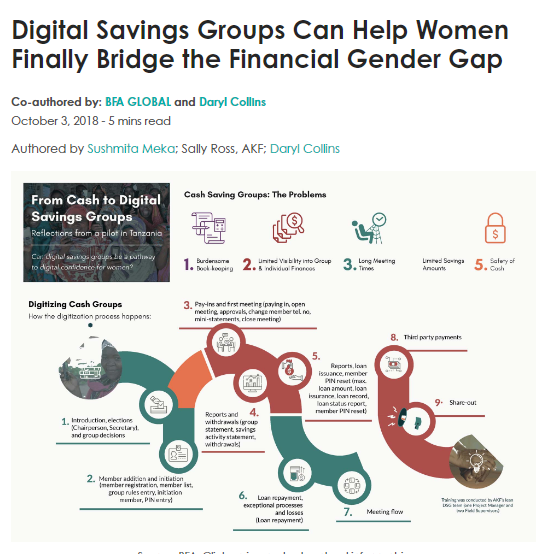
This report lays out a practical, proportionate approach to regulating savings groups—keeping the strengths of informality while opening pathways to safer savings, better governance, and stronger links with formal finance. Drawing from field research in East Africa and India, it offers a roadmap for policymakers to design light-touch regulation that lowers risk, improves data visibility, and supports women’s economic empowerment without overwhelming groups with compliance.