A Proportionate Regulatory Framework for Savings Groups
Financial Inclusion

A Proportionate Regulatory Framework for Savings Groups

Published by
Stefan Staschen
2025
View Resource

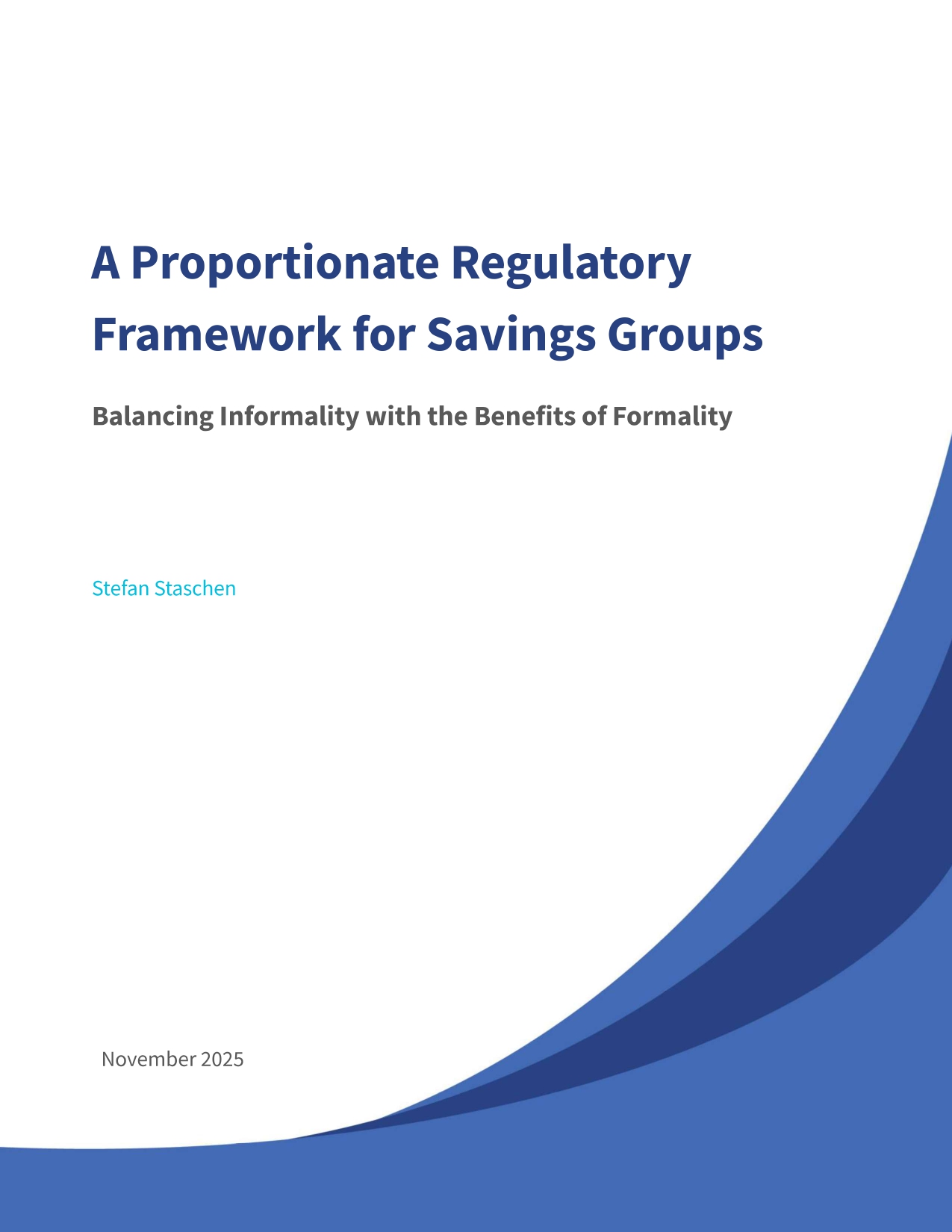
This report lays out a practical, proportionate approach to regulating savings groups—keeping the strengths of informality while opening pathways to safer savings, better governance, and stronger links with formal finance. Drawing from field research in East Africa and India, it offers a roadmap for policymakers to design light-touch regulation that lowers risk, improves data visibility, and supports women’s economic empowerment without overwhelming groups with compliance.
Leave a Reply

View all comments

Related Resources

Read
article
Financial Inclusion Financial Literacy Gender Mobile Money
GT VSLA Learning Brief ECA 2022 final Page 1
article
Financial Inclusion Financial Literacy Gender Mobile Money

Gender Equality through Savings Groups:
Gender Integration and Gender Transformative
Approaches in VSLA Programming

CARE
2023

Gender Equality through Savings Groups:
Gender Integration and Gender Transformative
Approaches in VSLA Programming

CARE has operated savings and lending programs through Village Savings and Loan Association (VSLAs) since 1991. This learning brief outlines CARE’s strategies to advance gender equality in these programs. The brief details experience from four VSLA projects in Uganda, Burundi, Rwanda, and Ethiopia which added gender transformative approaches to the traditional savings group model. Among […]
Read
Tool
Financial Inclusion
Building Pathways Illus v2_page-0001
Tool
Financial Inclusion

Building Pathways Conference

2025

Building Pathways Conference

The Building Pathways conference brought together key stakeholders to address a critical challenge in financial inclusion and poverty reduction: bringing capital and other financial services like insurance to financially excluded populations through village-level savings and loans groups (Savings Groups, SGs). These groups, in which women mobilize their own resources, have provided a vital source of investment and cash flow to people excluded from the formal financial system, especially rural women in Africa.