Research
Digital Inclusion Digital Payments Project Implementation

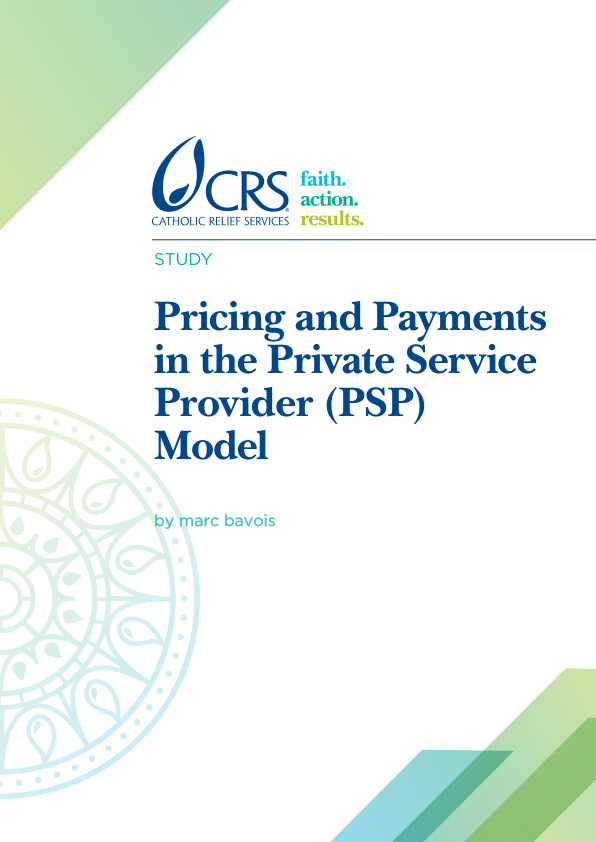
Pricing and Payments in the Private Service Provider (PSP) Model

Published by
Marc Bavois
2025
Catholic Relief Services
View Resource

This resource presents findings from Catholic Relief Services’ (CRS) Expanding Financial Inclusion in Africa (EFI) project, which tested the Private Service Provider (PSP) fee-for-service model across Burkina Faso, Senegal, Uganda, and Zambia. The study explores how different pricing strategies and training approaches affect affordability, sustainability, and poverty outreach in savings group programming.

CRS compared two fee structures—flat fees and proportional fees—and two training packages: the standard approach and a newly developed Pro-Poor Package (PPP). The research found that:

  • PSP fees were widely considered affordable, with 93% of group members reporting satisfaction.
  • Proportional pricing allowed PSPs to earn more while maintaining outreach to poorer communities.
  • The Pro-Poor Package helped PSPs moderate fees, resulting in lower payment-to-savings ratios for low-income members.
  • Flat fees were easier to implement but limited PSP income potential, especially in wealth-diverse communities.

The study also highlights the importance of transitioning from monthly to per-service payments in later group cycles to reduce financial burden and promote group independence.

CRS recommends adopting proportional pricing alongside the Pro-Poor Package to balance income generation for PSPs with inclusive outreach. These findings offer practical guidance for organizations designing or scaling fee-for-service models in savings group programs.
Leave a Reply

View all comments

Related Resources

Read
Tool
Data Privacy & Security Digital Literacy Digital Transformation Digitization Planning
DSG Toolkit
Tool
Data Privacy & Security Digital Literacy Digital Transformation Digitization Planning

DSG Toolkit: Tools to Support Safe and Gender-responsive Digitization of Savings Groups

By Lauren Hendricks, Dennis Mello, Paula Rudnicka
Global Communities, Women for Women International
2022

DSG Toolkit: Tools to Support Safe and Gender-responsive Digitization of Savings Groups

The DSG Toolkit, also available in Kinyarwanda, consists of seven practical tools to support safe, effective, and gender-responsive digitization of savings groups. These tools include practical guidance for implementers and trainers across multiple aspects of digitization, such as: Each tool can be used by implementers just beginning to think about their first DSG project and […]
Read
article
Digital Financial Services Digital Inclusion Digital Literacy Digitization Planning
Free Phones
article
Digital Financial Services Digital Inclusion Digital Literacy Digitization Planning

Can Free Phones Close the Gender Divide?

By Catherine Highet, Nisha Singh & Arisha Salman
Consultative Group to Assist the Poor (CGAP)
2021

Can Free Phones Close the Gender Divide?

This article explores the gender gap in mobile phone ownership and efforts to get phones into the hands of more women at the last mile. While these efforts have undeniably increased women’s access to phones, it is less clear if and how women are using phones to improve their lives. The article concludes that handset […]