
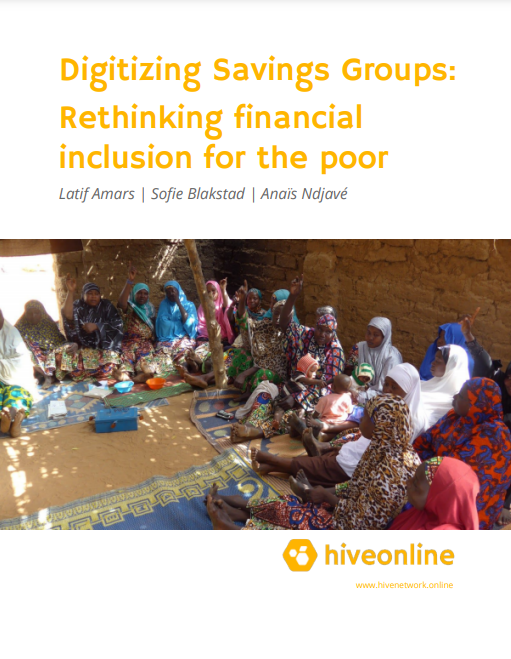
Hive COVER
Research
Digital Inclusion Digital Transformation Digitization Benefits Digitization Planning Financial Inclusion FinTech Program Quality Project Design Research Technology Solutions

Digitizing Savings Groups: Rethinking Financial Inclusion for the Poor

Published by
Latif Amars, Sofie Blakstad & Anaïs Ndjavé
2021
hiveonline
View Resource

This white paper, from hiveonline, explores the case for digitizing savings groups. The paper examines the challenges of reaching remote, poor populations and provides a brief introduction to the history, scope, and basic elements of the Village Savings and Loan Association (VSLA) methodology.

The paper notes that digitization of savings groups can result in the rapid acceleration of financial inclusion in developing countries. It can help solve challenges related to liquidity and access to formal financial services, develop a thorough financial history for groups and members, expand access to other services and support, connect savings groups to each other, address challenges related to low levels of literacy, improve inclusivity and trust, and strengthen remote monitoring.

Leave a Reply

View all comments

Related Resources

Read
Research
Financial Inclusion
dsg default resource
Research
Financial Inclusion

Impact of the Child-Optimized Financial Education (COFE) Curriculum among Savings Group Participants in Uganda: A Cluster Randomised Controlled Trial

By Eunsoo Timothy Kim, Yunji Zhou, Levicatus Mugenyi, Margaret Lillie, John Kato Bbosa, Collins Agaba, Andrew Mijumbi Ojok, John Hembling, Godfrey Kalemera Ruhangawebare, Carrie Miller, Thomas K. Shaw, Benjamin S. Allen, Joseph R. Egger, John A. Gallis, Joy Noel Baumgartner
Journal of Development Effectiveness
2025

Impact of the Child-Optimized Financial Education (COFE) Curriculum among Savings Group Participants in Uganda: A Cluster Randomised Controlled Trial

A randomized controlled trial in Uganda evaluated the Child-Optimized Financial Education (COFE) curriculum delivered through Savings and Internal Lending Communities (SILC). Results show that COFE significantly increased caregivers’ ability to pay for children’s school expenses compared to SILC-only groups. However, COFE did not significantly affect health-related spending or financial self-efficacy. Findings suggest that child-focused financial education can improve educational outcomes for vulnerable households.
Read
Brief
Digital Inclusion Technology Solutions
Brief
Digital Inclusion Technology Solutions

How CARE is Using WhatsApp to Power Digital Innovation in Savings Groups

By Eric Kaduru
CARE
2025

How CARE is Using WhatsApp to Power Digital Innovation in Savings Groups

This three-part brief series explores how WhatsApp is being used across CARE programs to train VSLA members, collect real-time data, and build powerful communities of practice among grassroots trainers.