
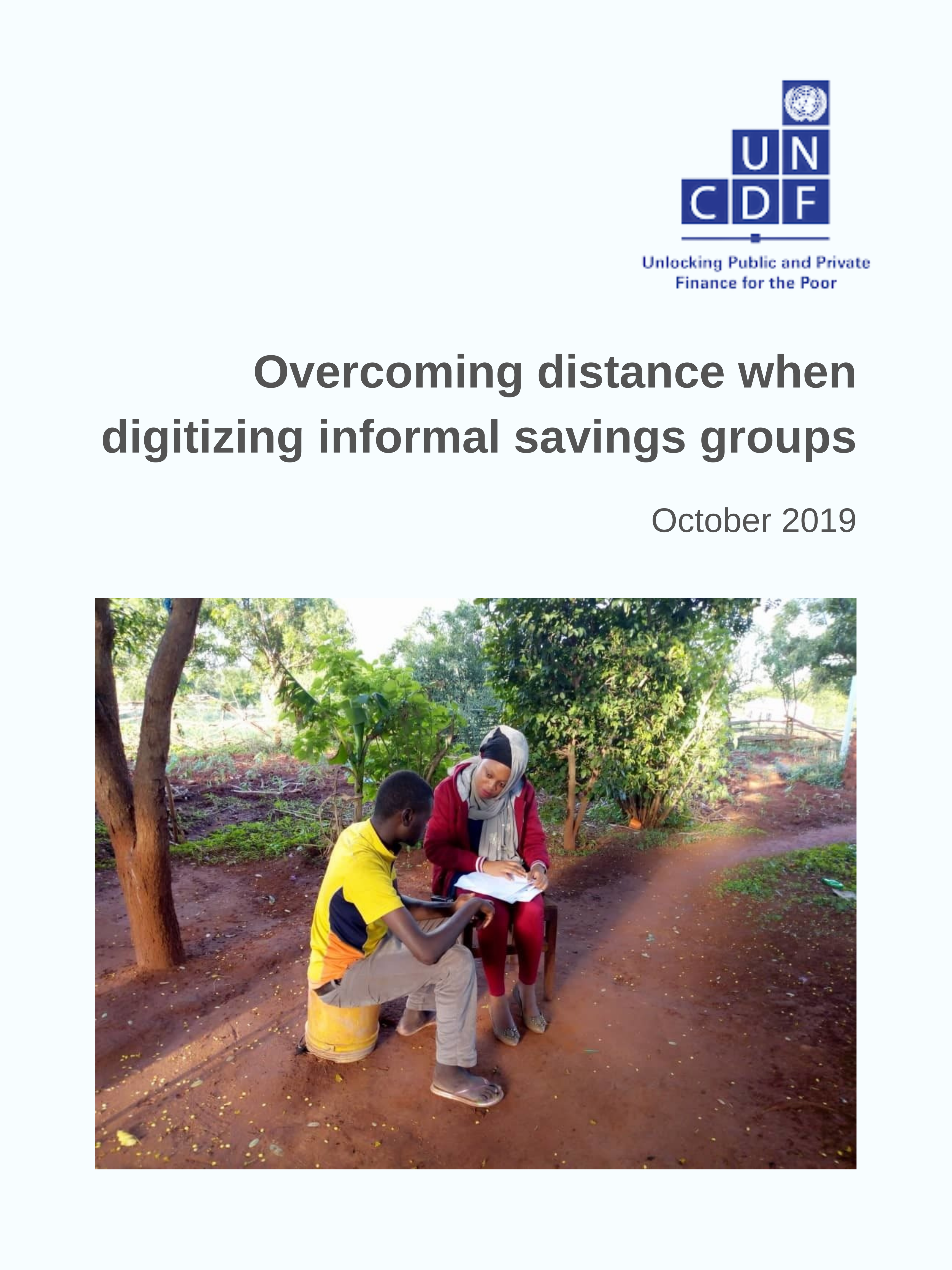
Overcoming distance

This article shares key findings from qualitative research conducted by UNCDF Tanzania and CARE International on the digital financial services (DFS) that are most appropriate for informal savings groups.

The authors outline two key findings. First, while mobile money is appropriate for individual accounts, there are difficulties around the validation of group accounts. Also, agent banking is more appropriate than mobile money for linking informal savings groups to banks. Second, information is key in providing pathways for digitizing informal savings groups. Despite agent banking and mobile money being commonplace, savings groups are often reluctant to use them to interact with banks if they do not have the required knowledge.
Leave a Reply

View all comments

Related Resources

Read
Brief
Born Digital Digital Recordkeeping Digital Transformation Digitization Benefits
BD vs. PTD
Brief
Born Digital Digital Recordkeeping Digital Transformation Digitization Benefits

Comparing “Born Digital” and “Paper-to-Digital” Groups

DreamStart Labs
2020

Comparing “Born Digital” and “Paper-to-Digital” Groups

This research brief highlights key insights from a study of digital savings groups (DSGs) conducted in rural Tanzania from August 2019 through February 2020. The research was led by the International Center for Research on Women (ICRW) working with savings groups supported by Project Concern International (PCI), a Global Communities Partner, and their Women Empowered […]
Read
RESOURCE
Financial Inclusion
A Proportionate Regulatory Framework for Savings Groups
RESOURCE
Financial Inclusion

A Proportionate Regulatory Framework for Savings Groups

By Stefan Staschen
2025

A Proportionate Regulatory Framework for Savings Groups

This report lays out a practical, proportionate approach to regulating savings groups—keeping the strengths of informality while opening pathways to safer savings, better governance, and stronger links with formal finance. Drawing from field research in East Africa and India, it offers a roadmap for policymakers to design light-touch regulation that lowers risk, improves data visibility, and supports women’s economic empowerment without overwhelming groups with compliance.