BFA article
article
digital divide Digital Inclusion Digitization Benefits Digitization Risks & Barriers Evidence & Impact Financial Inclusion Gender Mobile Money Social Inclusion User Experience

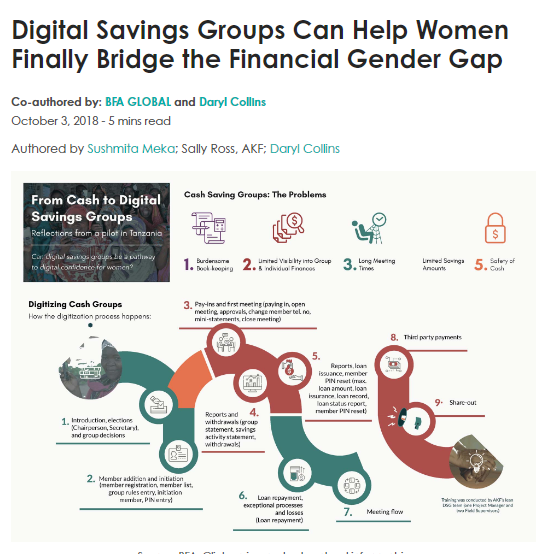
Digital Savings Groups can Help Women Finally Bridge the Financial Gender Gap

Published by
Sushmita Meka, Sally Ross & Daryl Collins
2018
BFA Global
View Resource

This article discusses the persistent gender gap in access to financial services and digital technologies. The key to closing both gaps may be found in savings groups, according to BFA, the Aga Khan Foundation (AKF), Financial Sector Deepening Trust Tanzania (FSDT), and the Bill & Melinda Gates Foundation.

Most savings groups are cash-based. But if these groups were to use cash alternatives, they could provide the bridge needed to help women across the digital divide. Based on the experience of a pilot project in Tanzania, the authors argue that the switch to digital is challenging, but the benefits are promising. Digital savings groups (DSGs) can improve the perceived safety of funds and save members time. Members can also grow more confident in using digital technology, as demonstrated by improved capacity to use mobile phones and mobile money, and improved perceptions of mobile money.
Leave a Reply

View all comments

Related Resources

Read
Research
Financial Inclusion
dsg default resource
Research
Financial Inclusion

Impact of the Child-Optimized Financial Education (COFE) Curriculum among Savings Group Participants in Uganda: A Cluster Randomised Controlled Trial

By Eunsoo Timothy Kim, Yunji Zhou, Levicatus Mugenyi, Margaret Lillie, John Kato Bbosa, Collins Agaba, Andrew Mijumbi Ojok, John Hembling, Godfrey Kalemera Ruhangawebare, Carrie Miller, Thomas K. Shaw, Benjamin S. Allen, Joseph R. Egger, John A. Gallis, Joy Noel Baumgartner
Journal of Development Effectiveness
2025

Impact of the Child-Optimized Financial Education (COFE) Curriculum among Savings Group Participants in Uganda: A Cluster Randomised Controlled Trial

A randomized controlled trial in Uganda evaluated the Child-Optimized Financial Education (COFE) curriculum delivered through Savings and Internal Lending Communities (SILC). Results show that COFE significantly increased caregivers’ ability to pay for children’s school expenses compared to SILC-only groups. However, COFE did not significantly affect health-related spending or financial self-efficacy. Findings suggest that child-focused financial education can improve educational outcomes for vulnerable households.
Read
article
COVID-19 Digital Financial Services Digital Inclusion Digital Payments
2023 01 31 07 33 47 About CGAP   Our Vision and Mission and 3 more pages Work Microsoft​ Edge
article
COVID-19 Digital Financial Services Digital Inclusion Digital Payments

Global Findex: Digitalization in COVID-19 Boosted Financial Inclusion

By Leora Klapper, Jean Pesme, Sophie Sirtaine
CGAP (Consultative Group to Assist the Poor)
2022

Global Findex: Digitalization in COVID-19 Boosted Financial Inclusion

This article discusses the 2021 edition of the Global Findex, the worldwide measurement of financial inclusion published by the World Bank Group. Specifically, the article highlights two major trends in the data: the growth in digital payments during the COVID-19 pandemic and the relationship between digital payment adoption and the use of other financial services. […]