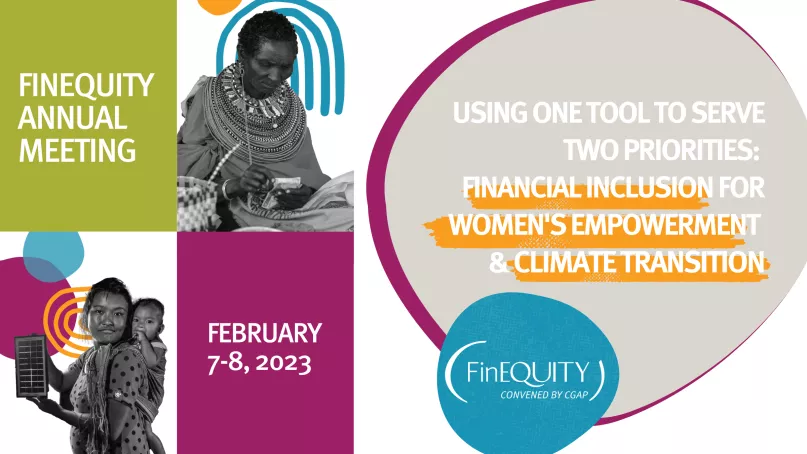
FinEquity Annual Mtg image

FinEquity’s 2023 Annual Meeting explored the nexus linking financial inclusion, women’s empowerment, and climate change, with the purpose of understanding how financial services can help women adapt their livelihoods to erratic rainfall patterns and rising temperatures to mitigate climate risks. Among others, the speakers addressed digitally-enabled financial inclusion, stressing the importance of designing digital financial services (DFS) with a gender lens and closing the digital divide, including through digital literacy strengthening. For example, in the session Perspectives on Financial Inclusion for Women’s Empowerment & Climate Transition the panelists discussed the opportunities and challenges of DFS in the context of climate change and cited the benefits of savings groups digitally linked to formal finance.
Leave a Reply

View all comments

Related Resources

Read
Tool
Consumer Protection Data Privacy & Security Digital Transformation Digitization Planning
Data Risks
Tool
Consumer Protection Data Privacy & Security Digital Transformation Digitization Planning

Quickly Identifying Potential Data Risks

By Amos Doornbos
MERL Tech
2022

Quickly Identifying Potential Data Risks

This resource is designed to help development actors increase the effectiveness of digital tools and data, while reducing the risks and the potential for harm. We often assume that data protection is the job of informational technology (IT) specialists. IT has a role to play, but so does operations staff. Operations staff determine what data […]
Read
Tool
Digital Inclusion Social Inclusion
Tool
Digital Inclusion Social Inclusion

The Value of Sharia-Compliant Savings Groups

Catholic Relief Services
2025

The Value of Sharia-Compliant Savings Groups

This brief from CRS explores how Sharia-compliant savings groups can expand financial inclusion in Muslim communities. By replacing interest with fixed fees, voluntary repayments, and group purchasing (Murabaha), these groups align with Islamic finance principles while still generating modest profit and fostering community trust. The model—successfully scaled in Niger—has seen strong acceptance from both members and religious leaders.