
Break the bias
article
Consumer Protection Data Privacy & Security Digital Inclusion Financial Service Providers Gender Industry Standards Risk Management

Break the Bias: Evidence Shows Digital Finance Risks Hit Women the Hardest

Published by
Majorie Chalwe-Mulenga, Yasmin Bin-Humam & Eric Duflos
2022
CGAP (Consultative Group to Assist the Poor)
View Resource

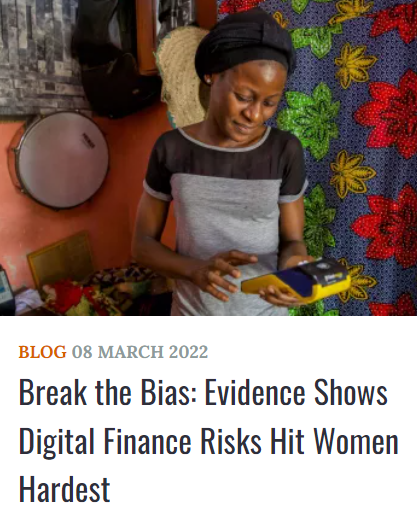
This article explores evidence which shows that women are more likely to experience most risks identified in CGAP’s typology of 66 DFS consumer risks than men. CGAP observes that long-standing digital financial service (DFS) risks are not only getting worse, but new risks are emerging every year, and women are more vulnerable to DFS risks than men. This has significant consequences for women’s financial inclusion. In addition to causing women financial hardship, experiencing or hearing stories of women who have faced consumer risks can discourage women from using mobile money, which is the main driver of financial inclusion in many developing countries. Negative experiences with DFS can also force women to revert to informal finance mechanisms, reversing progress in financial inclusion.

The authors argue that consumer risks warrant urgent action to ensure positive outcomes for women and vulnerable DFS users. They also provide a series of recommendations for regulators, supervisors, funders, and providers to help mitigate DFS consumer risks for women.
Leave a Reply

View all comments

Related Resources

Read
Tool
Consumer Protection Digitization Risks & Barriers Gender Personal Security
GBV Tool
Tool
Consumer Protection Digitization Risks & Barriers Gender Personal Security

DSG Toolkit: Addressing Risks of Gender-Based Violence

By Lauren Hendricks, Dennis Mello, Paulina (Paula) Rudnicka
Global Communities, Women for Women International
2022

DSG Toolkit: Addressing Risks of Gender-Based Violence

This tool was created to inform implementing organizations on the risks of gender-based violence (GBV) (including technology-facilitated GBV and intimate partner violence), which may occur as a negative consequence of a woman’s digital journey. The tool includes strategies to help mitigate these risks. Strategies could include community education, gender dialogues and GBV service mapping; promoting […]
Read
Brief
Digital Inclusion Technology Solutions
Brief
Digital Inclusion Technology Solutions

How CARE is Using WhatsApp to Power Digital Innovation in Savings Groups

By Eric Kaduru
CARE
2025

How CARE is Using WhatsApp to Power Digital Innovation in Savings Groups

This three-part brief series explores how WhatsApp is being used across CARE programs to train VSLA members, collect real-time data, and build powerful communities of practice among grassroots trainers.